Thank you to everyone who has shared feedback with us.
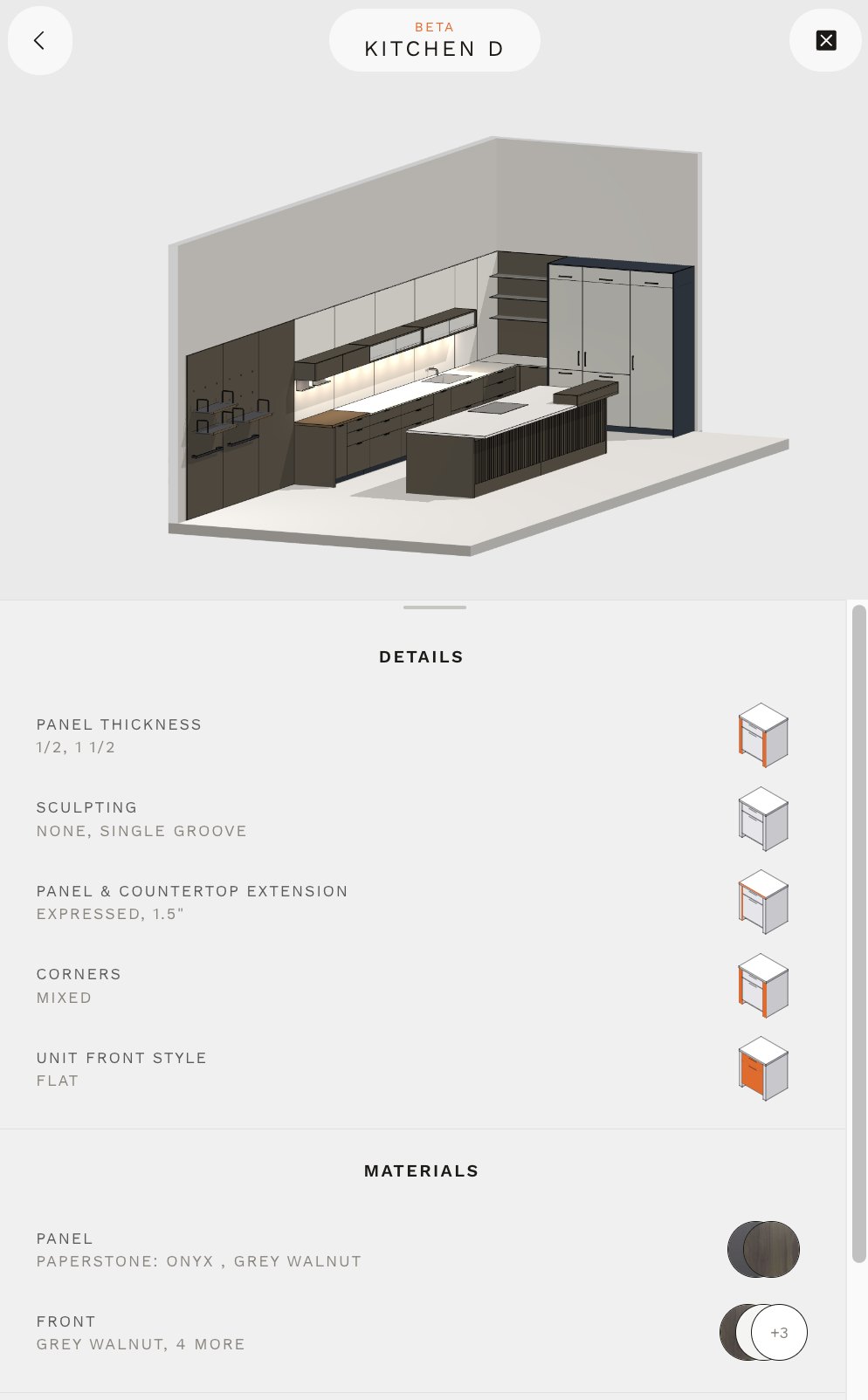
As of October 2026, we have implemented precision 3D in our Design Engine, the software we developed to allow us to optimize designing with our product system. These drawings are viewable, and soon configurable, using our Project Viewer, which we share with the client group in each project. This is a web-based application that works on both desktop and phone. This view enables:
- Panning and zooming in and out to see all details of product and how product meets architecture.
- Turning on and off of lighting, to clarify where lighting is speced and how it works within the space.
- Opening and close of drawers, fully outfitted with our interior component system.
- The critical construction and dimensional aspects that a builder needs to run plumbing and electrical, and to understand interferences with irregularities in walls, floors, or ceilings
- Dimensioned cross-sections of products and product configurations where they are required
- Export of overall model to various forms for Revit and other software.
As of Nov 1, kitchen lead times are being shortened from 24 to 18 weeks. This includes shipping times. Thanks to production capacity increases, our goal is to drop production lead-time to 14 weeks starting Feb 1, back to where it was before 2020.
Lead times for larger projects will be on a case-by-case basis, depending upon complexity.
Our integrated lighting has been a continuous COB (Chip-on-Board) hotspot-free LED for the last 5 years. We build the lights in our shop, install them, and pre-wire them so the length can be custom-fit to each unit. Light quality has been very good, but we found that the slightly protruding lens left a hotspot visible.
To solve this we designed an angled mounting bracket to tilt the light slightly back toward the wall and recessed it a touch more than the previous housing. These two details remove the illuminated lens from view, providing a more comfortable visual experience for our clients, even when sitting lower at a nearby table.
For closets, the same tilt lets us use a non-continuous, closet-rated linear LED inside closed units. This new light is being installed into all projects produced after Aug 1, 2026.
- 20° tilt toward wall
- 120° beam, diffused lens
- Back-end wiring, pre-wired at Henrybuilt
- No dead zones at ends of track
- 2700K (1290 lm/m) or 3000K (1470 lm/m)
- 18 W/m · UL listed / RoHS
- Continuous COB, hotspot-free
- Fully dimmable · 90+ CRI
- 2700K (1365 lm/m) and 3000K (1460 lm/m)
- 10 W/m · UL listed / RoHS
- Closet rated · node 2835, 128/m
- Fully dimmable · 80+ CRI
- Dual-mode universal dimming
- Phase and 0–10V, all major control systems
- PWM or constant voltage reduction (CRV)
- Flicker-free to <0.1% · IP66
Pocketing doors are popular in concept, but often frustrating in use—awkward to operate, often out of tune, and prone to breaking. Not comfortable settling for frustrations, the team opted to solve for them. Goal being to provide a door system that gracefully glides open and parks in unobstructive places, leaving storage and work areas accessible while in use, hidden away when not.
The new solid brass pivot hinge has three wide swing positions: 90°, 180°, and 270°. This allows us to design kitchens where moving elements add to the feeling of flow and ease, rather than detracting from it.
The hinges are easily tunable to the desired resting position, and designed so pulls have full clearance and do not hit the surface they open against or another pull.
Patent Pending
We’ve added 3 new morticed pulls to our collection and a new, much improved method of attaching all of our morticed pulls—a very high-strength connection that still allows easy removal and replacement if necessary.
Spring 2025 The Eclipse Pull. A circle pull, a little of a departure for us—an experiment introducing a round element to a morticed pull. It can be pulled from below, or from the sides.
Early 2026 The Pitched D Pull. A derivative of our most popular single pull, the D-Pull, designed by our founder in 2005. The Pitched D has a bolder look and is grabbable almost without looking, given its large opening, but like all of our morticed pulls, elegantly disappears into the reveal.
Spring 2026 The Morticed Staple 2. A morticed version of our face-mounted Staple 2. A strong-grip pull, with the added benefit that pulls can be matched in form, as with the Pitched D, on refrigerators, where a face-mounted pull is often required.
Patent Pending
Based on the success of our recently launched Client Experience program, we started a similar feedback program with our architect, design, and GC partners. We’ve learned a lot. The main lessons so far:
- Architects and designers want to know much more about how to design with our products. What are the options? What is flexible, what isn’t? We are excited about this and are developing tools to share more, and with more clarity.
- Detailed shops, early in the process, are so key to both designers and GCs. We hear you and are making these available.
- Fewer impactful reviews during the design process is ideal for most busy architects and designers, saving time and allowing greater focus. This is being implemented in all new projects.
- Renderings are incredibly helpful for our shared clients during the design process. Noted, and coming soon.
In 2023 we purchased our first zero-edge bander—a machine that uses tightly focused heat to fuse edging to panels without a seam—and began using it on soft-touch laminates. The aim was to move away from fragile pigmented varnish for continuous color to something more durable, very matte, and partially repairable.
After 2 years of positive results we purchased a second bander and began using FENIX, which provides many more and better colors. This highly durable material advances the aesthetic feel of color in the kitchen and elsewhere, and is a significant improvement to our material palette.
More detail from the maker of FENIX: “Created with proprietary technologies, the external surface of FENIX is characterised by next-generation acrylic resins, hardened and fixed through an Electron Beam Curing process. Super-matt, pleasantly soft, no fingerprints. Superficial micro-scratches can be thermally healed.”
Supporting homeowners in their use and enjoyment of our product has always been a tenet of Henrybuilt. Our lifetime warranty against defects in craft and material means we take this seriously, always providing care and support for our product over time. But we knew we wanted to do more for our clients.
In January 2025, we began investigating what it would take to create a more structured client experience program that would ensure every Henrybuilt client had the personalized guidance and support they needed throughout their experience of owning a Henrybuilt kitchen. We began collecting qualitative and quantitative data while working with homeowners, continuing through installation and move-in. Most of the data is gathered by observation. We do not do surveys.
Two primary areas stood out. 1. Communication. Clients were curious to hear more from us while their kitchen was in production and during the important moments leading up to delivery. 2. Set up. Clients craved more guidance and advice when setting up the functional components in their kitchens, or with their OpenCase, and to some extent in their dressing rooms.
At the beginning of 2026 we implemented a standard personalized system-setup visit for all clients. If they are within out-and-back-in-a-day driving distance of a showroom, we do it in person. If they are farther afield, we do this by Zoom or FaceTime.
So far, results are very positive, encouraging, and actionable. Clients are enthusiastic, and are getting more performance and flow out of their kitchens. We also get to see more of how clients use their kitchens right after installation, which feeds our improvement process. We are actively sharing this feedback with as many of you as possible.
While there is a lot of product information available in our recently released Product Viewer, we will be issuing the first version of a digital product guide in November 2026. It will be organized by room and illustrate key products and how they can be laid out and configured when designing. It will also provide the variables for each product.
If you have anything to share, we’d love to hear it. Your feedback is valuable to us and helps shape what we do next.